

How a Growth Director Solved Their Creative Partner Problem - And Why It Validated How We Work
Pedro Dinis, founder of AdArcade, recently wrote about something we hear from growth and creative managers constantly: the tension between giving a creative partner enough freedom to produce genuinely original ideas, and enough direction to make sure those ideas are actually useful.
This post is based on a case study originally published by AdArcade. You can read the original article here.
His article is one of the clearest breakdowns of this problem we've come across. We're sharing it here because it describes exactly how we think about creative partnerships, and because Pedro was kind enough to use AdSpawn as one of his examples.
The problem with too little direction
Pedro's original instinct was to give creative partners as much freedom as possible. No briefs, no guardrails, minimum input. If you want original ideas, stay out of the way.
It didn't work. Every creative partner, given no starting point, reached for the same obvious references: competitor ads, ideas that had already been tested, things everyone in mobile gaming has seen a hundred times. The freedom produced predictability.
The issue wasn't the freedom itself. It was that freedom without a starting point gives a creative partner nothing to push against.
The four-tier framework
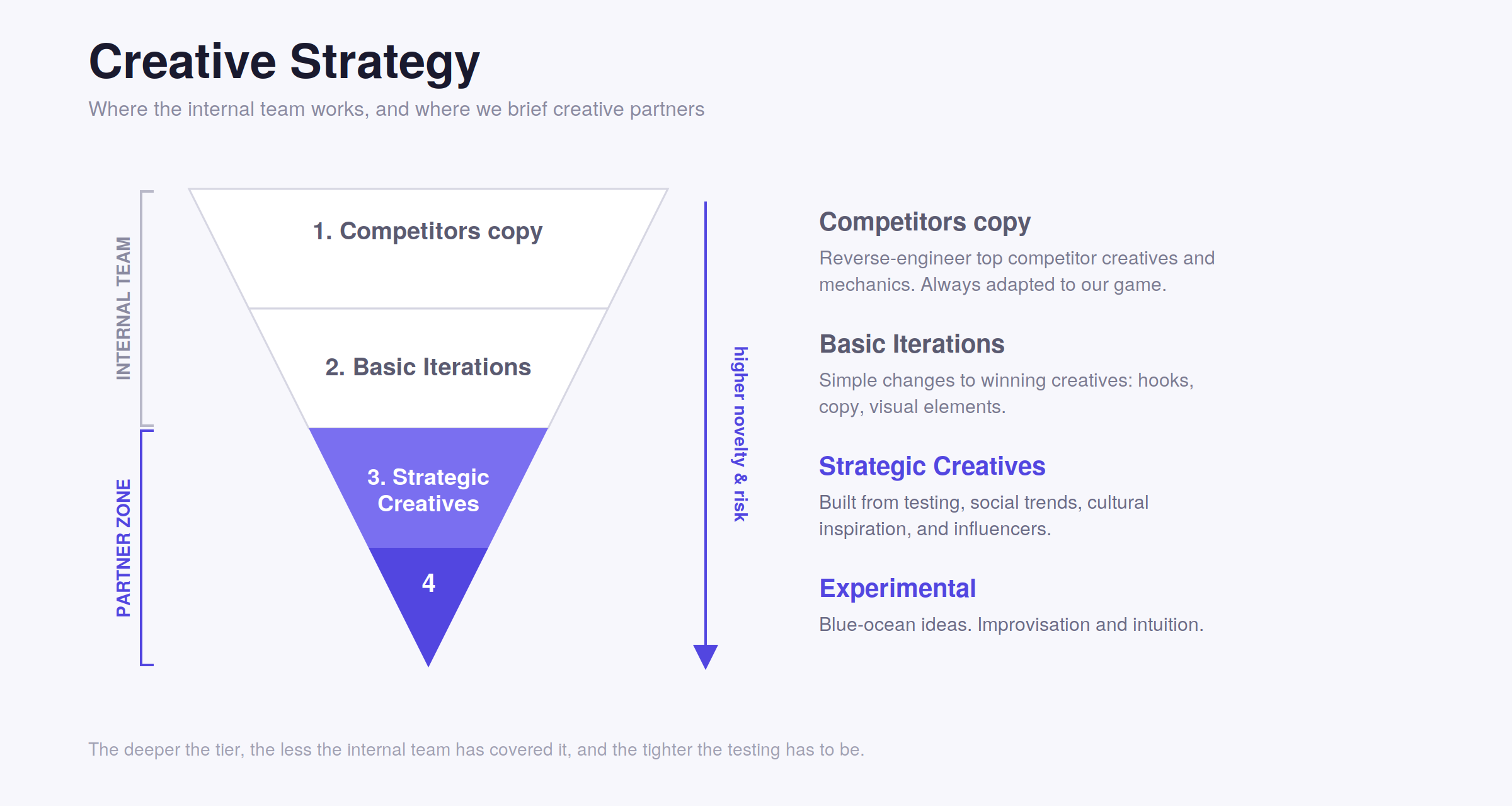
To fix this, Pedro mapped his studio's creative production into four tiers:
Tier 1: Competitor copies
Tier 2: Basic iterations on winning ads
Tier 3: Strategic creatives, concepts built from testing, trends, and cultural insight
Tier 4: Experimental, high-risk, high-novelty ideas
Tiers 1 and 2 are internal team territory. There's no point paying an outside creative partner to duplicate work your team already owns.
Tiers 3 and 4 are where an outside partner can actually add value, and where cultural relevance matters most. Pedro's internal team was based in China. His main markets were the US and EU. That gap was exactly what he wanted an outside partner to fill.
The catch: the bottom two tiers carry the most risk. Experimental concepts can swing overall performance in either direction. So the framework paired creative independence with tighter testing discipline. Freedom on the idea, rigour on the measurement.
Why AdSpawn landed on the first brief
Pedro tested roughly 30 creative partners using the same process. AdSpawn was one of the very few whose first delivery landed on brief.
A few things stood out. The concepts weren't competitor replicas. They were genuinely original ideas that combined characteristics from different creative angles in ways Pedro hadn't seen before. AdSpawn was also the first partner to independently deliver 60-second videos without being asked, which was directly relevant to the channels Pedro was scaling on (Unity and AppLovin). That told him we understood the channel, not just the format.
CPI on the first delivery was good, not after three rounds of revisions.
The one hesitation was our minimum three-month commitment. Pedro's instinct was to run a small test batch first. His conclusion: if you trust your own guardrails, the commitment stops being a risk. Good guardrails mean the partner is already pointed in the right direction before the first brief lands.
What this means for how we work
We prefer to develop ideas independently from a client's internal team. Not because we ignore context, but because the value we bring is thinking that hasn't been shaped by the same references your team is already working from.
That only works when there's a clear starting point. Pedro's framework is a good model: tell your creative partner what to avoid, where to push, and what you've already burned through. Then give them room.
The studios we work best with are the ones who've thought about this. They don't hand over a blank brief and expect magic, and they don't micromanage every concept either. They know what they want to test, and they trust us to find ideas worth testing.
If you're thinking about how to structure a creative partnership that actually produces new learning rather than a more expensive version of what you already have, Pedro's full article is worth reading. You can find it here.